
Sex Offender Checks in Milford
The controlling public source for Milford is the Connecticut Sex Offender Registry service, managed by DESPP and the Connecticut State Police. It may show a last known address, physical descriptors, and details about the offense location and date. Start there for a Connecticut location or name. Use the result as one part of a safety decision, not as proof of new conduct.
Milford Police does not maintain a separate public city registry identified in the official research. DESPP holds the statewide list, while police and the Sex Offender Registry Unit handle reports about possible noncompliance. That split matters. A police incident file and a registry profile answer different questions, and neither substitutes for a court docket.
Milford Searches Across State Lines
Milford's position near New York makes a state-only query incomplete when a person has lived or worked in another jurisdiction. The U.S. Department of Justice National Sex Offender Public Website sends a query across participating state, territorial, and tribal registries. Search Connecticut first for the state's own labels and details, then use NSOPW as the interstate layer.
| Channel | Best use | Key limit |
|---|---|---|
| Connecticut registry | Milford name or location research | Last known data, not live tracking |
| NSOPW | Cross-state name or place research | Underlying jurisdictions control records |
| Milford Police or SORU | Report a suspected compliance issue | Not a substitute search database |
The national search image comes from the official NSOPW service.
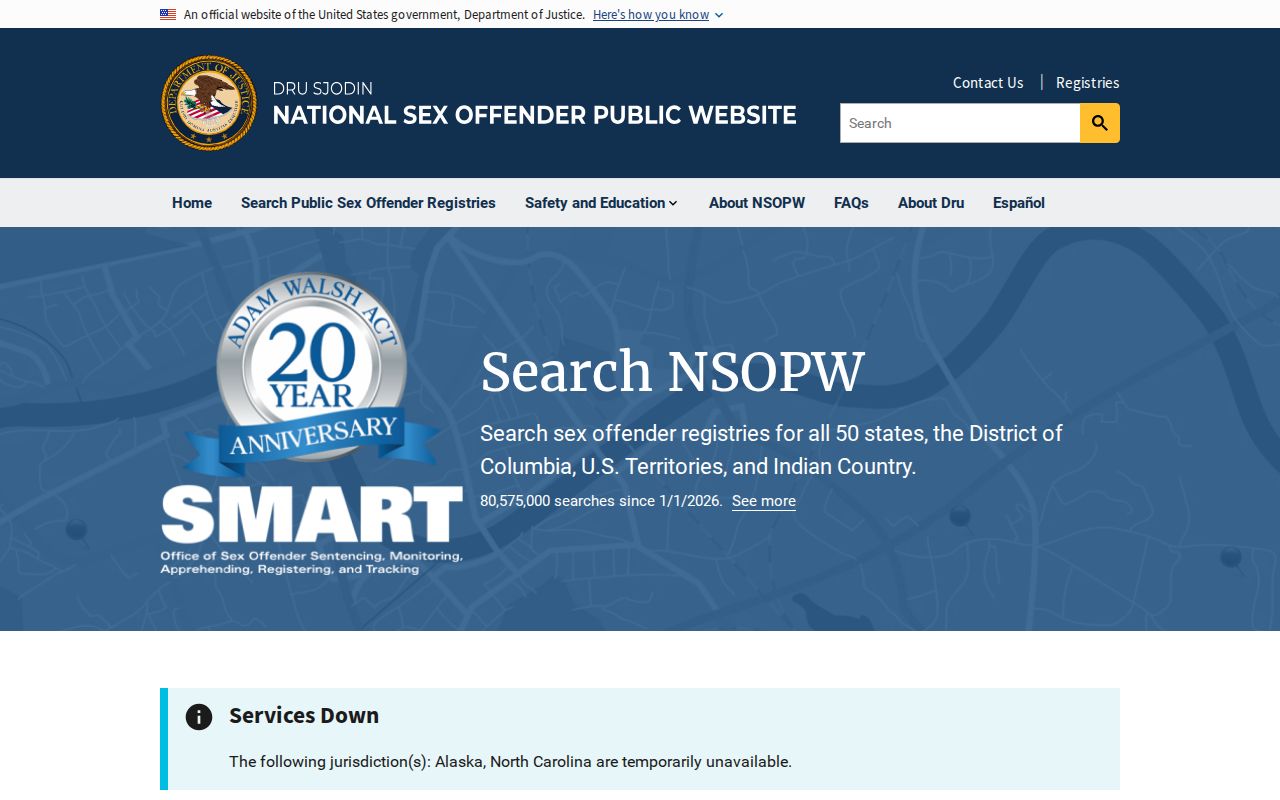
That federal layer is most useful after the Connecticut search, because a national result still leads back to the agency that owns the source profile.
How to Search the Connecticut Registry
Use a narrow, repeatable process and record when the query was made. Exact controls can change because DESPP serves the live application through a vendor. Do not assume radius values that are not visible on the current screen.
- Open the DESPP registry entry and enter the known name or Milford location.
- Use the city, ZIP, map, or list control only as the live application permits.
- Compare more than a name, including photograph, descriptors, offense information, and dates.
- Read whether an address is labeled residential and note its last update or verification language.
- Run NSOPW if prior locations or nearby states matter, then report inconsistencies to SORU or Milford Police.
| Field or control | Use | Caution |
|---|---|---|
| Name | First and last name route | Spelling and aliases affect matches |
| Address or location | Geographic search | Address is last known |
| City or town | Select Milford | Confirm current live label |
| ZIP | Narrow a place query | May not capture nearby towns |
| Map or list | Change result view | Availability can vary |
| Email notice | Subscribe to updates | Follow the state's current terms |
Milford Listings Are Not Risk Scores
DESPP expressly says it has not assessed each listed person's specific risk of reoffense and has not decided that a listed person is now dangerous. Public inclusion follows statutes and court outcomes. It should never be translated into a personal prediction.
This warning also explains why Connecticut terminology matters. Federal SORNA tiers may appear in national discussions, but Connecticut's public framework rests on offense categories, repeat status, court findings, and the controlling subsection of Chapter 969. A longer duty can signal a statutory category. It does not establish what a person will do next.
Inside a Registry Profile
A Milford public record can contain enough fields to separate two people with similar names, but visibility varies by statutory category. Never promise that the current interface will display vehicles, work or school locations, marks, victim age, or a risk label unless the live profile actually shows it.
| Identity | Name, aliases, photograph, and permitted identifiers |
|---|---|
| Physical description | Public descriptors authorized for display |
| Address | Last known address and category shown by the registry |
| Offense | Statute, description, location, and dates when public |
| Registration | Status and registration or release dates when shown |
| Limits | Fields depend on Connecticut law and the current interface |
Compare several points before concluding that a profile belongs to the person being researched. A shared name is not enough, and an old photo or address may require confirmation through the registry unit.
Read offense labels with care. A plain-language description can omit elements that appear in the cited statute, while a conviction or adjudication date is different from a release or registration date. If the wording is unclear, open the cited Connecticut provision rather than guessing from the label. Save the query date and note which fields were displayed. That small record makes it easier to explain a later change to SORU without copying or circulating a registrant's personal information beyond the official safety need.
Milford Last Known Address Limits
A registry address is not GPS data. It represents the last address reported and displayed under the state process. Someone may have moved, a written update may be processing, or a result may contain an error. Do not visit the address to investigate.
If a Milford entry seems internally inconsistent, preserve the public details and date of the search. Contact the Sex Offender Registry Unit or Milford Police. Staff can evaluate compliance through official records that are not part of the public search. Publishing extra personal details or confronting a resident can create harm and interfere with an inquiry.
Connecticut Registration Levels and Requirements
Connecticut General Statutes Chapter 969 governs the exact duty. Connecticut does not use one universal public Tier I, II, and III danger scale. Common patterns include ten years for specified nonviolent sexual offenses or offenses against a minor, and life for sexually violent, repeat, or other listed categories. Court orders and statutory changes can create case-specific results.
| Statutory framework | General duration | How to read it |
|---|---|---|
| Qualifying nonviolent or minor-victim category | Commonly 10 years | Exact statute, date, and conviction control |
| Sexually violent, repeat, or enumerated category | Life | Verify the applicable Chapter 969 subsection |
| Court-ordered or reclassified matter | Case-specific | Read the order and current law |
The official statute image is drawn from the Connecticut General Assembly's current Chapter 969.
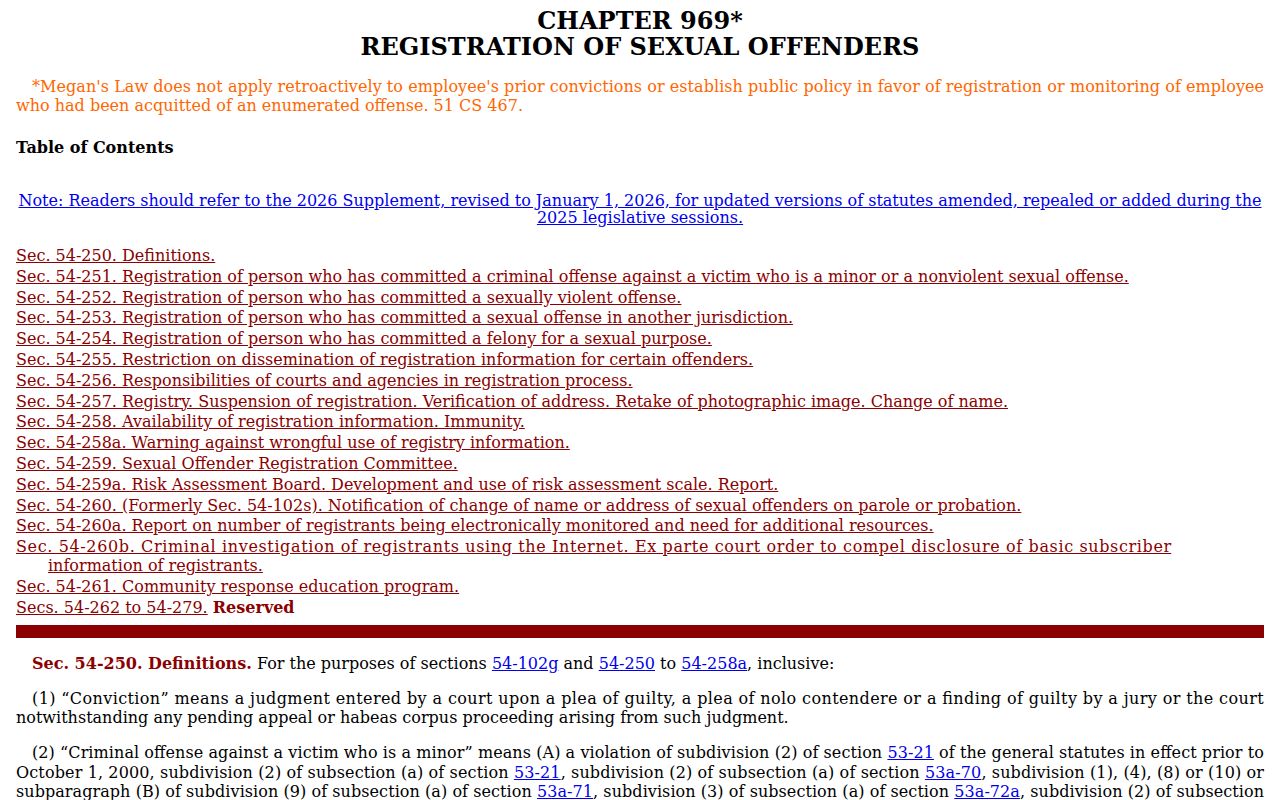
The statute, not a shorthand label on another website, is the right place to resolve a disputed registration period.
Milford Duties Route Through SORU
The DESPP Sex Offender Registry Unit is at 1111 Country Club Road, Middletown, CT 06457. Its public contact is 860-685-8060, fax 860-772-1730, and SORU@ct.gov. The advisement form states that initial in-person registration is generally due within three days after release, or without undue delay, described as within five business days, after establishing Connecticut residence from another jurisdiction. Public counter hours listed on that form are weekdays from 9 a.m. to 3 p.m., except holidays.
Milford Police remains the local contact for suspected failure to register or an urgent safety concern. The state unit owns the registry process. This division prevents a common mistake: sending a public search question to a city records clerk who cannot alter the statewide profile.
Five-Day Milford Address Rule
Connecticut's address change or confirmation form requires written notice within five days. It asks for the registrant's printed name, date of birth, whether the filing changes or confirms a residential address, the prior and new full street addresses, effective date, signature, and date. A post office box is not a substitute for the full address.
This is a registrant compliance form, not a tool for a member of the public to edit another person's listing. Suspected stale data should be reported. It should not be “corrected” by sending a form in someone else's name. False information or a registration violation may constitute a Class D felony under the governing provisions.
The timing rule also shows why a recently changed Milford address may need official review before anyone draws a conclusion. A public user sees the displayed profile, not the intake workflow behind it. SORU can compare the filing, effective date, and registry update. Milford Police can receive a local report. Neither route calls for a neighbor to collect evidence at the listed home.
Milford Registry Email Notices
The state service advertises free email notification. Follow the live DESPP route to see the current place choices and terms. Alerts can help with ongoing community awareness, but they do not replace a fresh registry check when a specific safety question arises.
The official registry-service image is sourced from the Connecticut State Police registry entry.
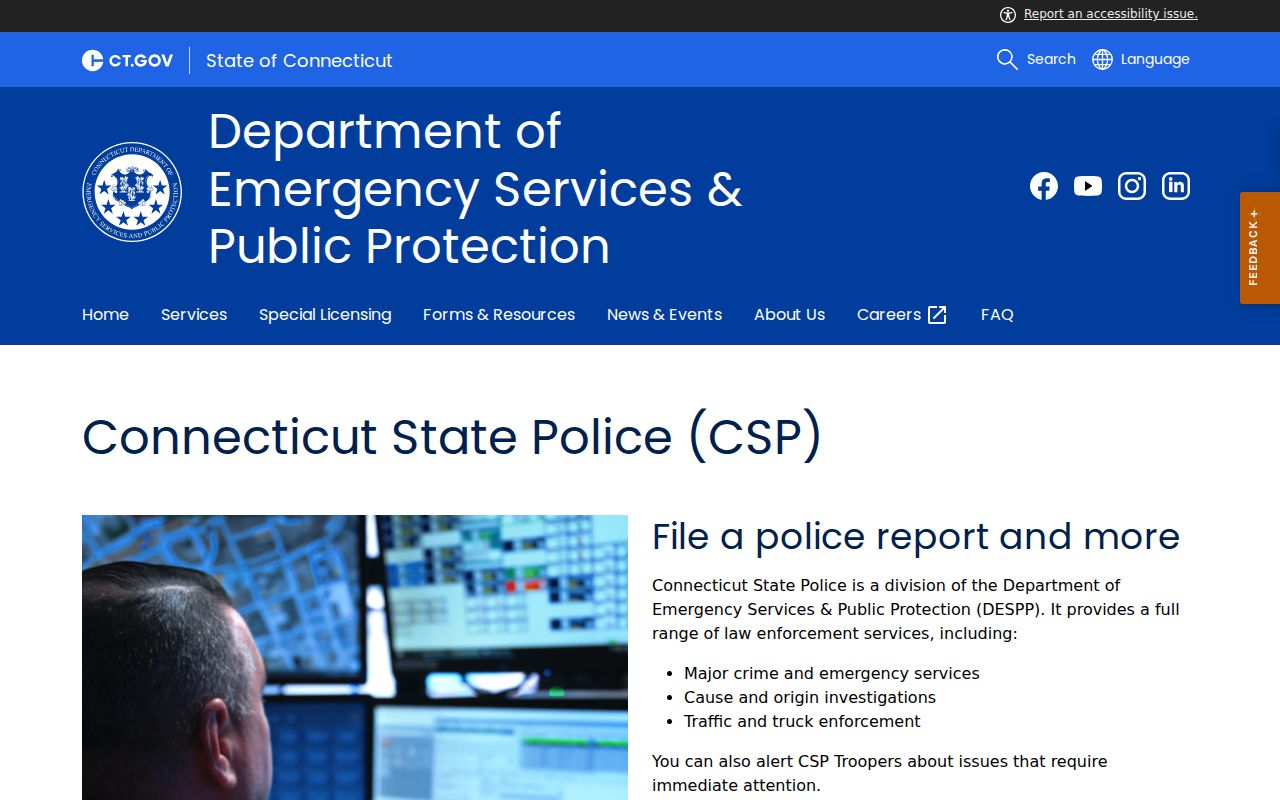
The DESPP entry is also the correct starting point if a saved link to the vendor search changes.
Community Notification and Lawful Use
Registry information supports personal, family, and neighborhood safety. Confirm identities, respect the state's warnings, and send concerns to police or DESPP. Do not contact a listed person, threaten anyone, post extra private data, or organize vigilante action. A profile records a qualifying legal history and a statutory duty. It does not prove current misconduct.
Use registry data lawfully: Chapter 969 warns against misuse. Harassment, threats, intimidation, or interference based on registry information may be criminal and should never replace a report to Milford Police or DESPP.
For an immediate threat, call emergency services. For a data discrepancy or suspected failure to comply, use SORU at 860-685-8060 or Milford Police general service at 203-878-6551. Give staff the public profile details and the date checked, then let the responsible agency investigate.